
The most expensive mistakes in a custom home are not made in the field. They are made, or avoided, months earlier, on a screen. A house is thousands of decisions that have to agree with each other, and a disagreement costs the most on the day it turns up on site. So we settle them first. We coordinate before we construct.
A house is thousands of decisions that have to agree
Custom home building is a chain of dependencies. The duct has to clear the beam. The beam has to clear the window head. The window head sets the ceiling line the client fell in love with. Move any one of them and the rest move with it.
Resolve that chain on paper and the build stays calm. Discover it on site and every link becomes a change order, a delay, and a callback. It is not glamorous work. It is the difference between a house that comes together and one that fights you the whole way.
Move one, move them all
The duct
routes first, and has to clear the beam.
The beam
carries the load, and has to clear the window head.
The window head
sits under the beam, and sets the ceiling line.
The ceiling line
the one the client fell in love with.
Move any one of them and the rest move with it. We settle that on paper, months before a wall goes up.
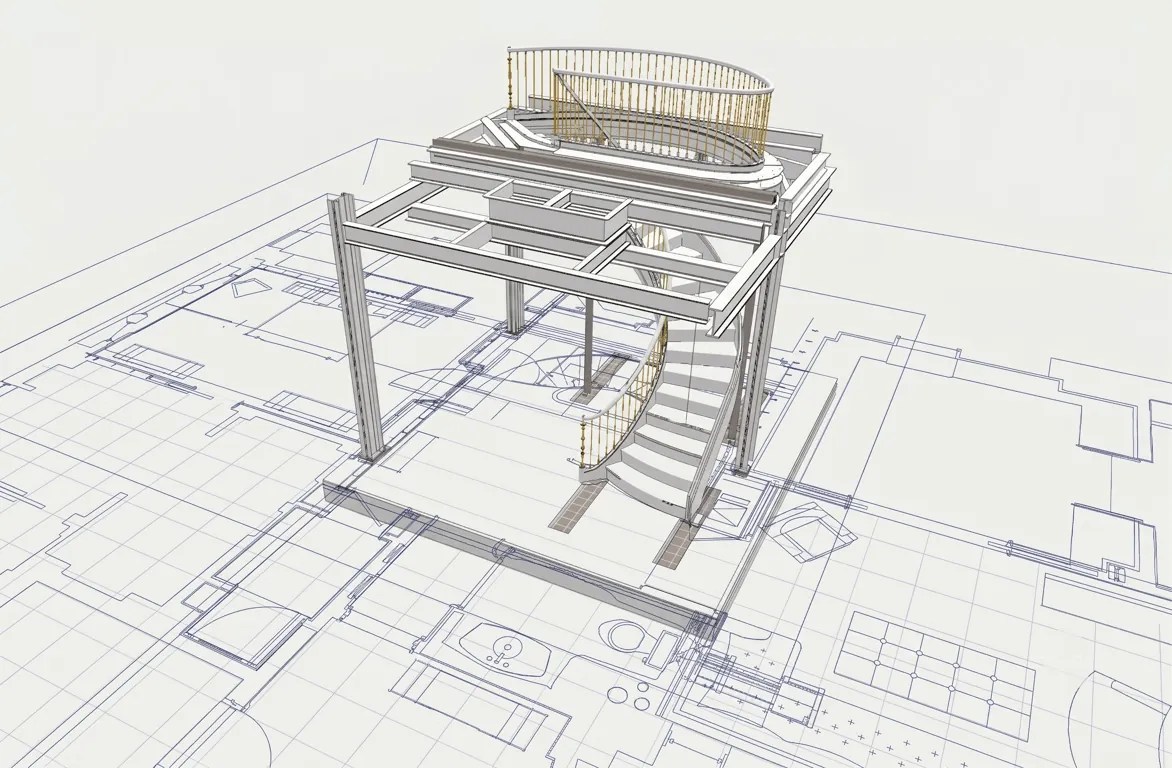
You work with not only an architect but a whole team of architects, coming up with hundreds of pages of design documents.
The mechanicals decide it
Ask Scott Hobbs where a custom build is won or lost and he goes straight to the mechanical systems. On a speculative house, the heating and cooling might be a hundred thousand dollars and four or five zones. On a custom home, it can reach half a million, with thirteen or fourteen zones, a whole run of radiant heat, and variable speed air handlers.
None of that fits itself into the house. Every run, every zone, every register has to be coordinated against the structure and the finishes before the framing closes and hides it. Get it right on paper and the systems disappear into the house. Get it wrong and you are opening a finished ceiling to move a duct.
The runway is measured in years, not weeks
Before the first delivery truck arrives, a custom home has already lived a long life on paper. You find the architect, who is busy. You interview, you choose, you move through a design process. Then approvals, then permits, then you line up the builder, who is also busy. Scott Hobbs counts that runway in years rather than weeks, often two to four years before a shovel moves.
We use that time. It is where we bring the mechanical, structural, and millwork trades into design development, while the drawings are still being drawn, and model the house until the conflicts surface and get solved. By the time the runway ends, the hard questions already have answers. That is the whole point of coordinating before we construct.
Coordinating before construction, in brief
- What does coordinating before construction mean?
- It means bringing the mechanical, structural, and millwork trades into design development, while the drawings are still being drawn, and modeling the house until the conflicts surface and get solved on paper. Fewer conflicts reach the field, so there are fewer change orders. See how we work.
- Why do custom homes run over budget and behind schedule?
- Most often because conflicts are found in the field instead of the office. A duct meets a beam, a beam meets a window head, and the fix on site is a change order, a delay, and a callback. Resolving that chain during design is what keeps a custom home on plan.
- How long does custom home building take before construction starts?
- The pre-construction runway, finding the architect, the design process, approvals, and permits, can run two to four years on a complex home. Used well, that time is where coordination prevents the problems that would otherwise show up on site. More in how we work.
- Where does Hobbs build?
- Hobbs builds and renovates across the Hamptons, New York City, New Jersey, and the Fairfield County and Litchfield County area of Connecticut. See our work.
More to read and watch


Stay in the conversation
More from the Journal
New writing on how a Hobbs home comes together, and each new Conversation, delivered as it publishes.
Working on a home of your own? Start a conversation.
To hear Scott Hobbs talk this through in his own words, watch the full conversation on Boroughs and Burbs.